Press, PR & Media
Can Robots Understand Personal Space?
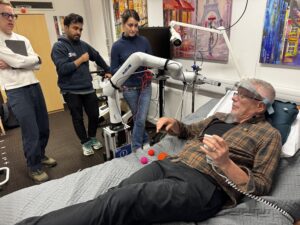
The Pamper Factory project ran a second workshop on the 26th of February in the Cobot Maker Space, University of Nottingham. The aim of the workshop was to further explore the concepts of intimacy and proximity when humans and robots interactant. This helped the Somabotics team and Blast Theory to think about a new artwork that’s being developed!
Matt Adams from project partners Blast Theory led an introduction to the workshop. Participants used the principles of proxemics to measure personal space. Data about comfortable distances between two people, and between people and robots was captured. This helped us to understand the different the ways that people experience being in the same space as each other and ‘intelligent’ technologies, such as robots!
“Soft robotics is the perfect form for exploring intimacy and AI. Soft robots – especially those that use silicone – can simulate the texture of human skin. They are inherently fuzzy and soft around the edges. I’m really excited to explore how soft robots can simulate some of the feelings that we might have as we grow more intimate with AI.” Matt Adams, Blast Theory.
The team wanted to explore technologies designed for subtle, unobtrusive interaction – intimate interfaces – objects that blur the line between the user’s body and digital system and spent time building three prototypes:
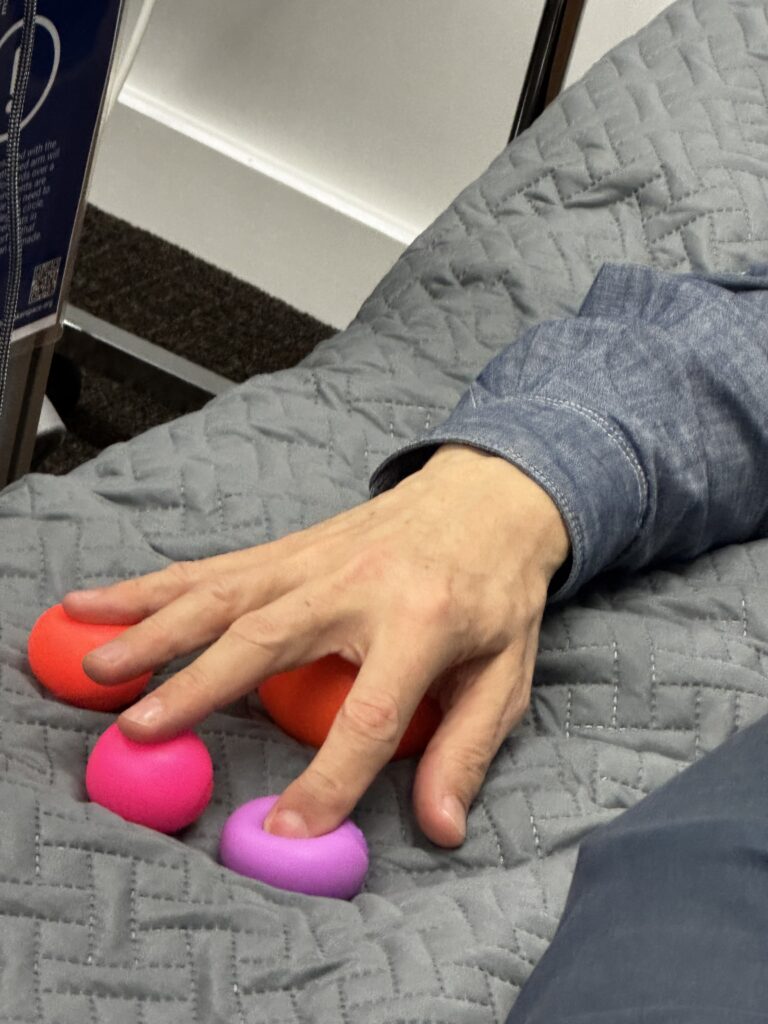
- A hand operated control input suitable for five digits of one hand made using soft balls or pads. Each digit used pressure to control the potion and zoom level of a camera
- A camera mounted robot arm that tracks up, down, left and right with a camera streaming video to a monitor in real time
- An inflatable mat/cushion that inflates and deflates in response to the touch by the user’s hand
The three prototypes were then used to explore a scenario in which a person lies on a surface, while their body is moved and ‘touched’ in different ways by a series of inflatables. They control a camera that approaches them, enabling it to explore their face in close up, exploring parts of their face in detail which might not normally be seen by the naked eye. Our Soma Skins system was used to explore and quickly create prototypes for these sorts of experiences.
Dr Alan Chamberlain, leading this strand of research said “Should robots understand people’s personal space? We are working on the design of intelligent robotic systems that can creatively build upon our understandings of personal space and intimacy. The ways that we deal with space, movement, touch and distance are complex and can impact upon ways that we interact with the world and robots! It’s possibly something that most people take for granted, but it’s something that we need to think about when we engage with robots.”