
Press, PR & Media

Embrace Angels Explores Human-Robot Interaction in Amsterdam
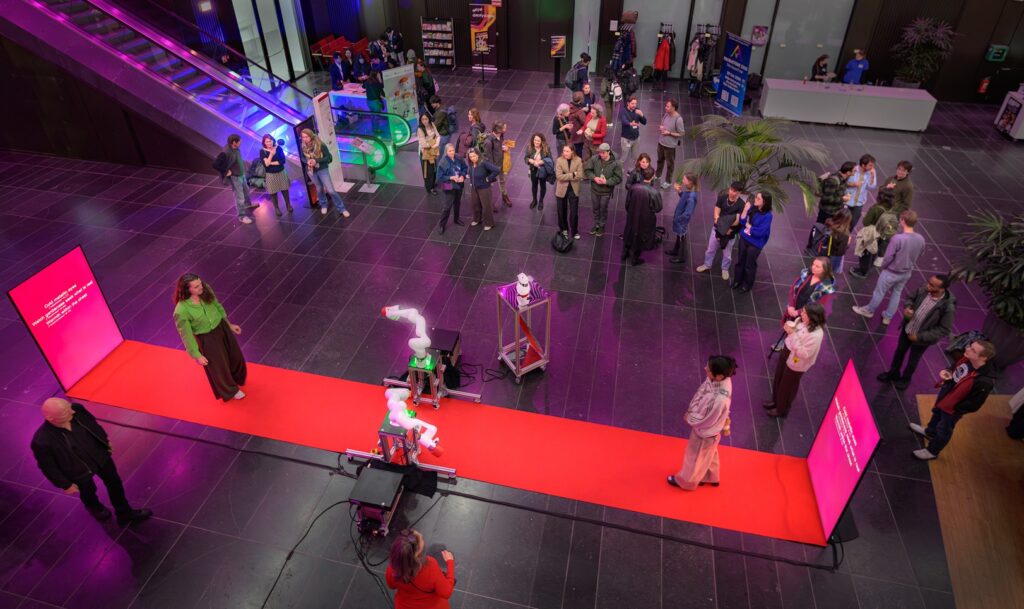
Researchers and artists behind the Embrace Angels installation recently travelled to Vrije Universiteit, Amsterdam for the third public iteration of the project, using the opportunity to test new features and gather valuable insights into how people interact with robotic systems powered by artificial intelligence.
Following previous showings at Nottingham Contemporary and the Cinekid Festival, the Amsterdam exhibition attracted a notably different audience, including many students studying robotics and AI. This led to a wide range of technical questions and discussions, providing a unique opportunity to explore the installation’s technological aspects in greater depth.
A key focus of this latest iteration was testing automated movements as part of ongoing work towards the eventual full automation of the robotic arms that form the core of the installation. On the first day, the Reachy Mini conversational robot was programmed to guide participants through the experience. However, it quickly became apparent that visitors responded more naturally when the artists [Karen Lancel and Hermen Maat] themselves mediated interactions. Communication between the two robotic systems proved challenging, with participants’ conversations influencing the robotic arms in ways that varied depending on participant positioning.
These observations provided valuable insights for the team. Researchers noted that conversations with artists often took longer than the automated explanations provided by Reachy Mini, requiring adjustments to the timing of the robotic arm movements. This practical testing highlighted important considerations for future development and deployment.
The exhibition also revealed some limitations of large language models (LLMs) when interpreting human interactions. During the first day, for example, the system struggled to recognise and capture embraces correctly, leading some participants to be repeatedly prompted to hug multiple times. While unintended, this provided moments of humour and opened up discussions about the reliability and behaviour of AI systems in real-world settings.
Further challenges emerged when the AI attempted to interpret personal relationships. In one instance, participants explained that they lived together, which the system incorrectly interpreted as evidence of an intimate relationship. These examples offered valuable learning opportunities and demonstrated the complexities involved in designing AI systems capable of understanding nuanced human experiences.
The team also discovered that the language model frequently generated similar responses regardless of the conversations taking place. Following analysis, researchers concluded that the use of leading questions may have influenced these outcomes, providing another important lesson that will inform future iterations and research design.
Following a project debrief, plans are now being explored for a fourth public iteration of Embrace Angels in 2027. In the meantime, development will focus on enabling the Reachy Mini robot to better understand and facilitate the process of creating an embrace, before instructing the robotic arms to respond appropriately.
The Amsterdam exhibition generated a wealth of new data that will support the next phase of experimentation and development and overall, the team’s time in Amsterdam proved extremely valuable, providing important insights that will help guide the future evolution of Embrace Angels.