
Projects

AI LENS
AI LENS forms part of Somabotics’ wider exploration of relationships between humans, machines and emerging technologies.
The project builds on Embrace Angels, an artist-led performance exploring human–robot interaction through the act of embracing. That work was documented using an earlier prototype of the AI LENS system, providing an initial exploration of how AI-generated imagery could become part of a live physical interaction.
AI LENS extends this approach from documentation towards generative cinematography — asking how machines might become active participants in the production of moving images.
The project sits across art, filmmaking, artificial intelligence, human–computer interaction and creative technology, using practical experimentation to explore what new forms of image-making might emerge from these intersections.
AI LENS is an experimental camera system that uses generative AI to transform moving images as they are being filmed.
Developed by artist and filmmaker Dr Richard Ramchurn, AI LENS explores what happens when the traditional relationship between a camera and the image it produces is disrupted.
Instead of showing the camera operator a conventional live image, AI LENS replaces the traditional monitor with a continuously generated image. What the camera sees becomes the starting point for an evolving visual interpretation, shaped in real time by camera movement, framing, lighting, performance and interaction with the AI model.
The result is a new kind of cinematographic process in which the final image is not simply captured by the camera, but emerges through a negotiation between human performance, cinematographic operation and artificial intelligence.
From camera to generative instrument
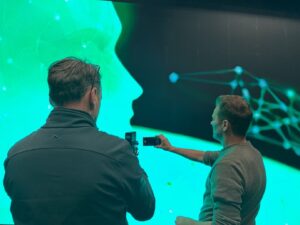
Conventional filmmaking separates production and post-production: the camera records an image, and visual effects and other transformations are applied later.
AI LENS brings some of this transformation into the moment of filming.
The filmmaker can move the camera, alter the framing, change the lighting and interact with the generative system while watching the resulting image evolve. This creates a feedback loop between the physical world and the generated image, making cinematography itself part of the generative process.
AI LENS builds on research into adaptive media, embodied interaction and human–AI creativity, and continues Somabotics’ exploration of new relationships between people, machines and creative technologies.
A camera that generates
AI LENS investigates a simple but fundamental question:
What happens when the camera is no longer just capturing an image, but actively participating in its creation?
During filming, the camera provides the visual input for a generative model. The resulting image is displayed to the filmmakers in real time, creating a continuous feedback loop between camera, performer, environment and AI.
Movement can change the composition. Framing can alter what the system generates. Lighting can transform the resulting image. The filmmaker can also influence the generative process through direct interaction with the system.
This makes the camera less like a recording device and more like a generative instrument.
The process introduces new possibilities — but also new uncertainties. The filmmaker has to work with a system that can produce unexpected results, requiring decisions to be made in response to images that did not previously exist.
For Filmmakers, Artists and Researchers
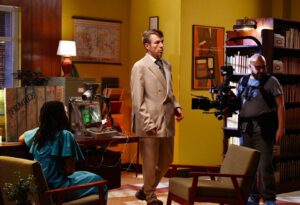
AI LENS is being developed as both a filmmaking system and a research platform.
For Filmmakers
AI LENS explores new approaches to cinematography, virtual production and visual effects. It offers directors, cinematographers, camera operators and creative technologists the opportunity to experiment with generative imagery at the point of capture rather than exclusively in post-production.
For Artists
The system provides a space for experimentation with live image-making, performance and generative media. Artists can use the relationship between physical action and generated imagery to create work that is responsive, unpredictable and continuously evolving.
For Researchers
AI LENS provides a practical environment for investigating human–AI creativity, agency, authorship and embodied interaction. Rather than treating AI as a tool that simply produces an output from a prompt, the project explores what happens when people and generative systems influence one another through an ongoing physical and visual process.
Outputs and Highlights
AI LENS: Stories from the Latent Space, The Broadway Cinema, 29th September 2026: blog
AI LENS at Amsterdam International Broadcasting Convention
BASILISK: An experimental short film created through real-time generative cinematography
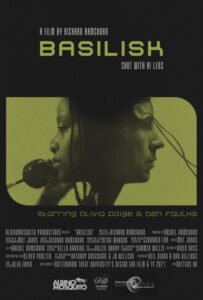
Basilisk is the first of three films created using AI LENS.
The film transforms live camera footage through generative AI during filming. Rather than recording a conventional image and applying visual effects afterwards, the filmmakers work directly with an image that is continuously generated and transformed.
Basilisk follows two people performing a mysterious, ritualised process in a secluded office. As images provoke increasingly disturbing transformations, the boundary between human perception and machine intelligence begins to dissolve, leaving the characters trapped within a system whose purpose they may no longer understand.
The film’s visual language is created through a negotiation between human performance, cinematographic operation and artificial intelligence. The resulting images are not simply illustrations of the story. They emerge from the interaction between what is happening in front of the camera and what the generative system produces in response. Basilisk therefore becomes both a film and an experiment in a different way of making films.
Richard Ramchurn, Alan Chamberlain, Angela Higgins, Steve Benford, Paul Tennent, Kieran Woodward, Dominic Price, Gabriella Giannachi, Rachael Garret, Christok Kitsidis, Karen Lancel, Herman Maat. AI Lens: A Live Generative AI Camera System for Dynamic Image Transformation. UKAI conference 2025.
Workshops for Filmmakers and Film Artists 25 November & 12 December 2025